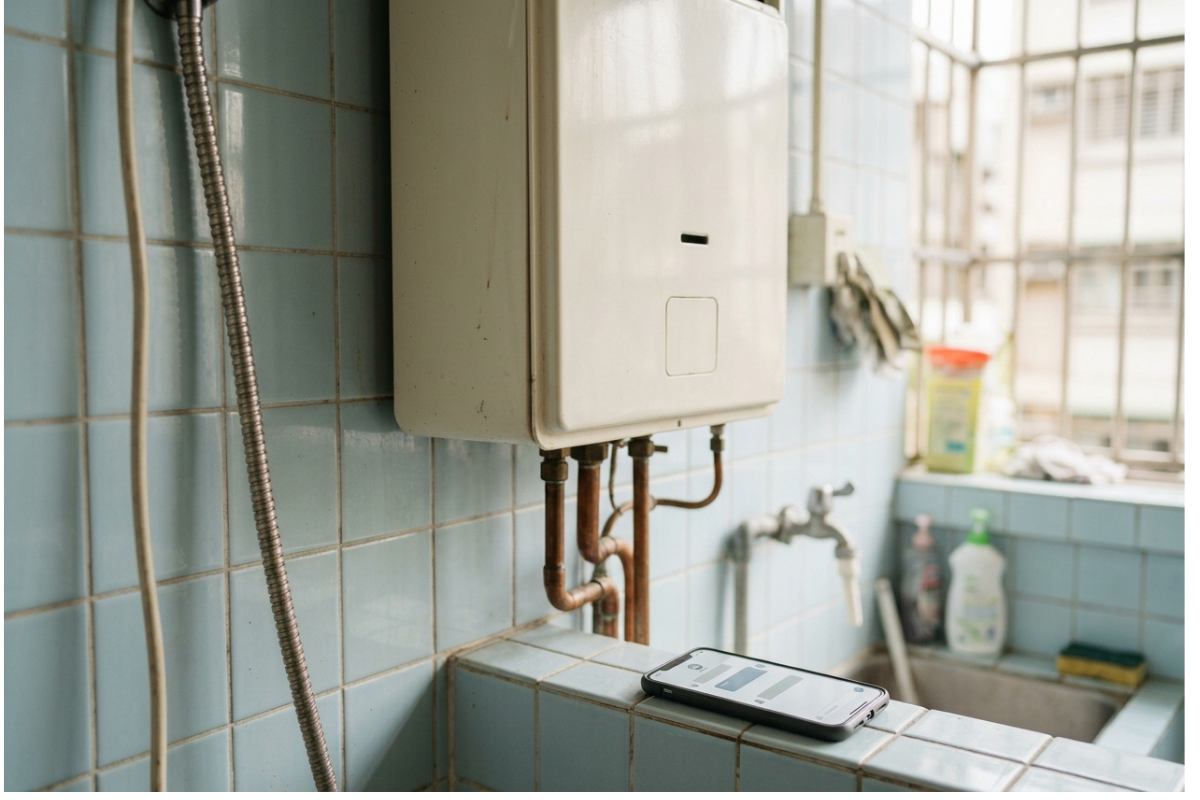
Last week, I turned on the hot water and heard none of the familiar clicking.
Oh! Were the batteries dead?
I replaced them. Nothing.
Next, I wondered if the battery compartment had rusted. The following day, I inspected it carefully, but there was nothing wrong with it. I took off the water heater’s front cover, and the inside looked clean and almost new too.
Could it be the ignition unit, I wondered—the same part that had failed in our previous water heater?
Since last year, we had already replaced our refrigerator and washing machine. I really did not want to spend money on yet another new appliance.
As I tried to work out what might be wrong, a thought occurred to me: why not ask AI? Maybe it could help me track down the problem one step at a time.
For the First Time, I Understood What the Water Heater Was Doing
So I started talking to AI and sent it photos of the water heater.
After working through a few possibilities, we first confirmed that the gas supply was fine. Then AI asked me to turn on a hot-water tap and watch whether any of the parts inside the heater moved.
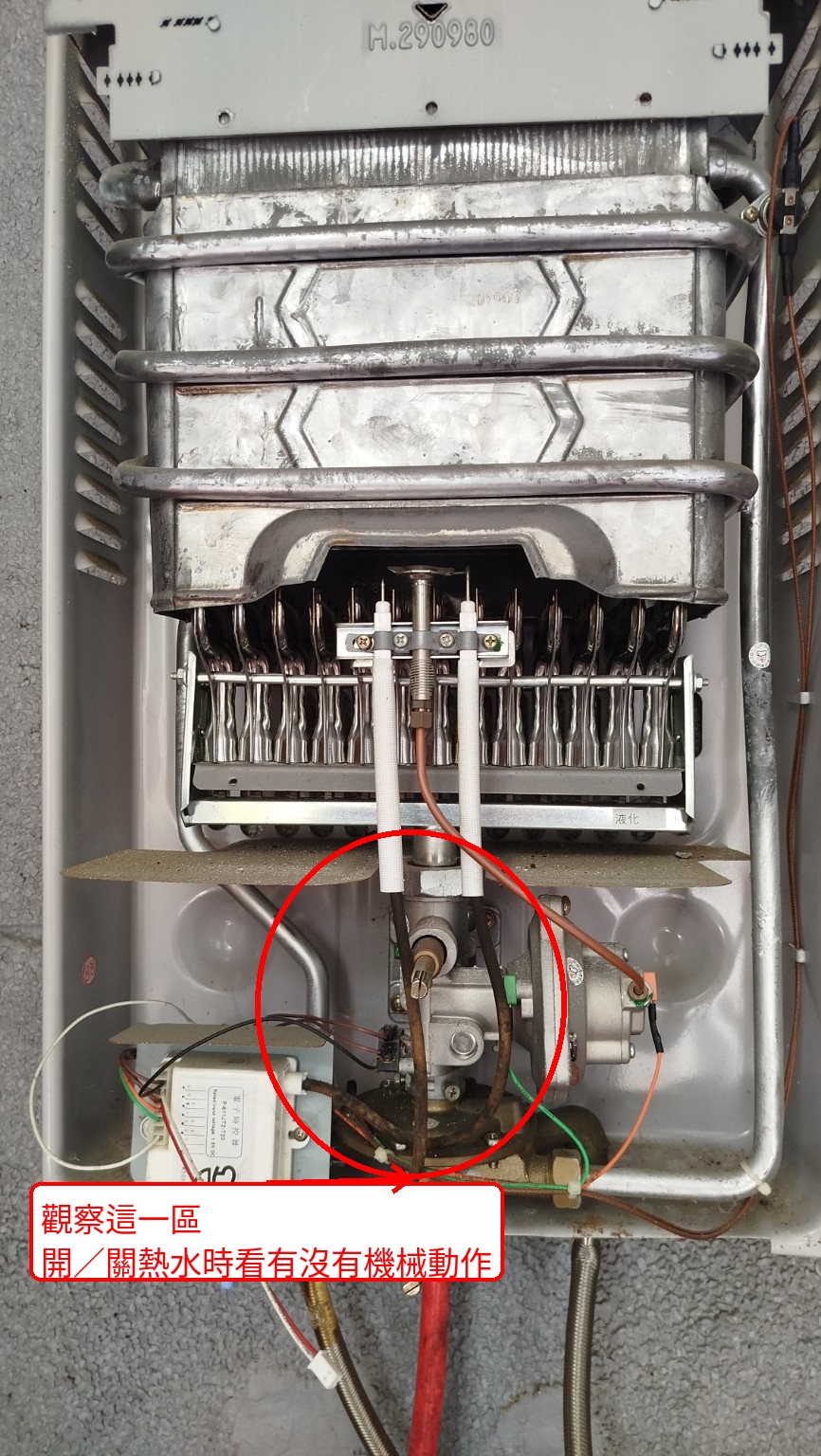
▲ The photo of the water heater's interior that I sent to AI. I watched the mechanism inside the red circle as I turned the hot water on and off.
Sure enough, when I turned on the hot water, a horizontal rod inside rose; when I turned it off, the rod dropped again.
Above the rod was a small plate, and above that was the microswitch.
AI explained that a traditional gas water heater like this generally works as follows:
Turn on the hot water → water flow activates the diaphragm mechanism → the linkage triggers the microswitch → the igniter starts clicking → the gas valve opens → the main burner ignites → hot water flows
Whenever I ran into something I did not understand in the past, I would search Google and YouTube, slowly piecing together an answer from one keyword and one video at a time. This time, through a back-and-forth conversation, I began to understand what the water heater in front of me was actually doing.
Since I had already changed the batteries but still heard no clicking from the igniter, I took a closer look at that horizontal rod.
That was when I noticed it did rise, but always fell just a little short of reaching the microswitch above it.
So I carefully tested the linkage mechanism.
“Whoosh!”
The burner lit!
I have to admit, that was pretty exciting.
At least this moved the troubleshooting forward. The problem seemed to involve the incoming water flow or the linkage, rather than the whole appliance simply being dead.
Next, I recorded a video of the heater operating and sent it to AI. It used a diagram to explain the water diaphragm assembly and how water flow pushes its internal diaphragm to move the linkage.
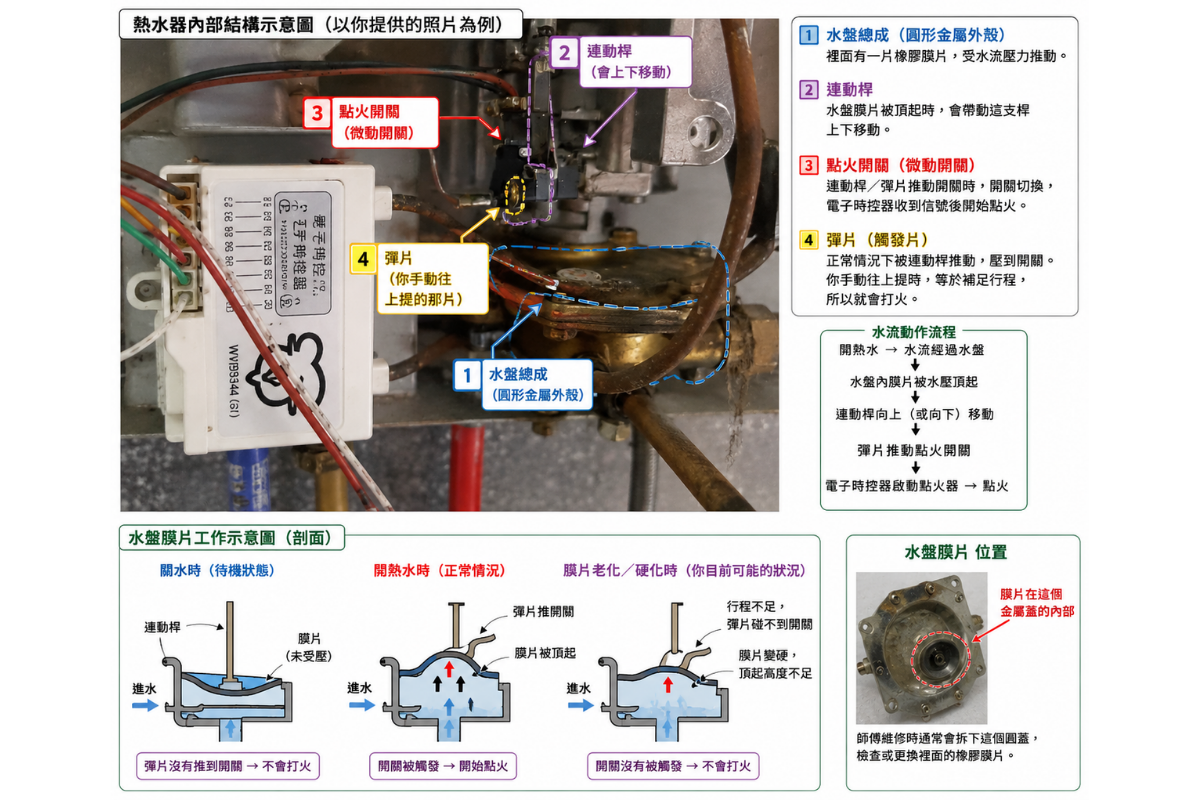
▲ AI’s diagram of the mechanism based on the photo. After our back-and-forth questions and answers, the parts I had not understood began to fit together.
The possible causes gradually narrowed down to a few things:
An aged or hardened diaphragm, or insufficient linkage travel → a problem with the actuator plate or microswitch position → insufficient actual water flow
The first possibility best matched what I was seeing.
The rod was not completely motionless. Rather, it moved, but did not rise high enough.
So I boldly settled on my first suspect: the diaphragm inside the water diaphragm assembly.
If years of use had made it stiff and less flexible, it could prevent the linkage from traveling far enough.
All right, then. I would replace it!
I immediately placed an order on Shopee before 2 p.m.
It arrived the next day and cost NT$120.
A New Diaphragm Should Fix It, Right?
The part arrived on the second evening, and I put off replacing it until the following day.
I asked my husband to help, and we cleaned out the scale inside while we were at it.
Once the new diaphragm was in place, I fully expected the water heater to spring back to life.
The result—
Nothing.
It did not ignite at all.
Even more confusingly, the ignition response I had managed to produce during my earlier tests had now disappeared too.
Huh?
What was going on now?
I had no idea which part of the process had gone wrong, so I started the troubleshooting sequence all over again.
Power?
Gas?
Wait—could it be the hose?
I looked at the hose, which had become slightly twisted and misshapen, and decided to check it again.
This time, the heater ignited!
Only for a moment, but at least something had changed.
Unfortunately, after being removed, reattached, and bent several times, the old hose had also developed a tiny hole.
Well then.
The testing had to stop.
Once again, everything would have to wait until tomorrow.
Day Three: How Are We Back Where We Started?
On the third day, I bought a new hose.
I installed it and tried again.
Ignition.
Once.
The flame would not stay lit, and the problem seemed to have returned to square one.
Oh, no…
By then, my husband had had enough.
“Let’s just replace it.”
But I still could not make up my mind.
After coming this far, was I really going to give up?
To be fair, my husband would be paying for the new water heater, so I should have happily agreed.
And yet one question kept circling in my mind:
What was actually wrong?
In the end, all I said was:
“Let me think about it…”
Getting My Time Back
The next day, I found myself imagining taking the water diaphragm assembly apart and inspecting it all over again.
But what if I still could not fix it?
Then a phrase suddenly came to mind:
“Get your time back.”
Right.
Hot water was not the only thing I was short of. I was short of time too.
I still had a pile of other things to finish. What if I spent another afternoon taking the heater apart, putting it back together, and testing it, only to end up with nothing?
Wanting to fix it was one thing.
Being able to fix it was another.
And deciding whether it was worth spending more time on it seemed to be yet another question.
Enough. It was time to ask someone.
I messaged the owner of an appliance shop I had contacted earlier. I had originally asked him for an estimate on installing a new air conditioner, so I took the opportunity to ask about the water heater too.
The technicians came over that afternoon.
I gave them a quick account of the past few days: the troubleshooting, the dismantling and reassembly, and the diaphragm replacement.
During the initial test, the rod still moved, but it still did not rise far enough.
After looking it over, the owner suggested replacing the entire water diaphragm assembly rather than just the diaphragm.
It seemed as though that was the end of the discussion.
Then the story suddenly took a turn.
The Problem Was Never Inside the Water Heater
The younger technician noticed something none of us had paid attention to before:
There was a big difference between the cold- and hot-water flow rates.
He suspected there might be resistance or a blockage somewhere in the hot-water line.
While everyone else went upstairs to inspect the air-conditioner installation site, he stayed downstairs alone and continued checking the water heater and plumbing.
When the others had finished, he gave me an answer I had never expected:
“The water heater isn’t broken. The problem is at the showerhead.”
Huh?
What?!
He removed the showerhead and hose, then turned on the hot water—
And the heater ignited!
It hit me like a bolt from the blue.
I suddenly remembered that I had replaced the showerhead and hose on the very morning I began testing the heater. The new hose was also longer than the old, damaged one.
That immediately reminded me of something our neighbors had experienced.
Even after replacing their water heater, they still could not shower normally, and eventually had to install a booster pump.
It turned out that whether the water heater starts properly depends on more than simply having water. The flow rate through the heater matters too. If there is too much resistance at the outlet and the flow becomes too low, it can prevent this kind of flow-activated heater from operating.
After going around in such a huge circle, I could not believe the problem had been there all along.
Mystery Solved
After the technicians left, I immediately found a shorter shower hose and installed it.
Then I turned on the hot water again.
“Click, click, click—”
“Whoosh!”
The burner lit.
And the hot water really came back!
Wow—the mystery was solved.
I had spent days checking the water diaphragm assembly, replacing its diaphragm, cleaning out scale, and changing hoses. I had even started wondering whether to buy an entirely new water heater.
In the end, the crucial detail was a shower hose.
Looking back, though, I cannot say that everything I did beforehand was a complete waste.
Replacing an aged part and checking the plumbing brought different possibilities to light and allowed me to reconsider them one by one. Through all the observing, dismantling, reassembling, and testing, I also came to understand more about how the heater works. Gradually, I could see the relationships among the water flow, water diaphragm assembly, actuating rod, microswitch, and ignition system. It was no longer simply a matter of replacing whichever part seemed broken.
AI did not fix the water heater for me.
But it helped me break down a problem I knew nothing about and understand what I was seeing one step at a time. It was a little like having an on-call repair consultant who would answer every question.
This experience also showed me a common blind spot in troubleshooting.
Once we find an explanation that sounds reasonable, it is easy to keep digging in that same direction.
I saw that the rod was not rising high enough, so I followed the trail deeper into the heater: the water diaphragm assembly, the diaphragm, the microswitch.
But what finally changed everything was one very simple observation:
Why was there such a big difference between the cold- and hot-water flow rates?
Sometimes, when we cannot find a problem, it is not because we have not dug deeply enough.
Maybe we just need to step back and look at the whole system again.
Of course, I learned another very practical lesson too:
Time is also part of the cost of a repair.
If I had taken the water diaphragm assembly apart one more time that day, I might simply have continued running in the wrong direction.
Knowing when to investigate something yourself—and when to stop and ask someone more experienced—is perhaps part of solving the problem too.
So I cannot say that those days of taking things apart and putting them back together were wasted.
At least now, when I look at the water heater on the wall, I have some idea of what all those parts inside are busy doing.
Most importantly—
I understand it better than I did before.
Safety note: This article records my personal troubleshooting and learning experience; it is not a guide to repairing gas water heaters. Gas appliances involve fuel gas, ignition, carbon monoxide, and other safety hazards. If any work requires dismantling or adjusting gas-related components, or if the cause of a fault cannot be confirmed, have the appliance inspected and repaired by a qualified professional.