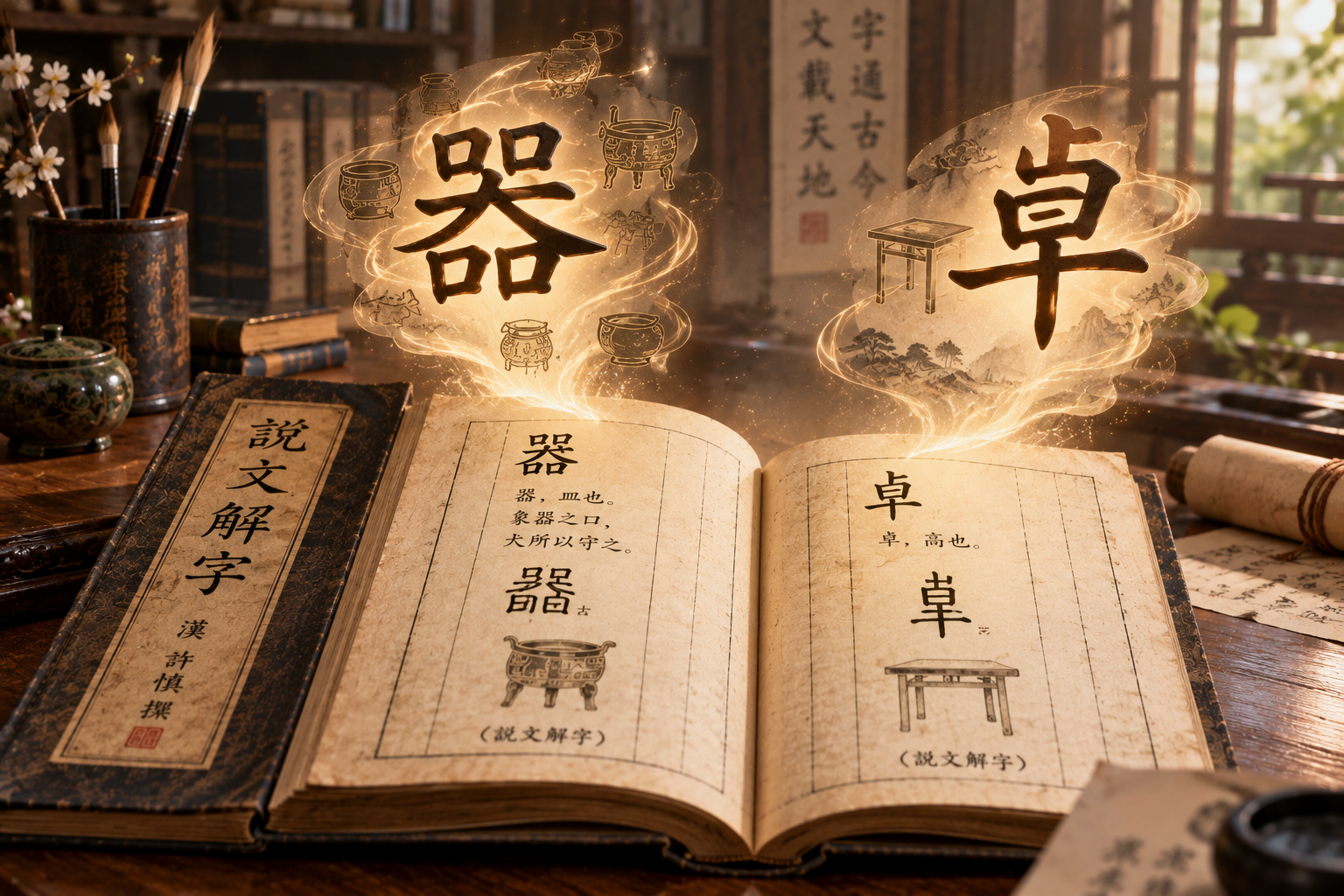
During a recent language exchange with a Japanese friend, I noticed something tiny but intriguing. As I was explaining that 壺 was a kind of container, I realized that the 器 she wrote was missing a dot. I told her she had written it incorrectly. But after checking an online dictionary, I discovered that although we were writing the same character, Japan’s 器 and Taiwan’s 器 did not look quite the same.
The form taught in Taiwan has 犬 in the middle. In the form currently used in Japan, the middle is written as 大, with one fewer dot.
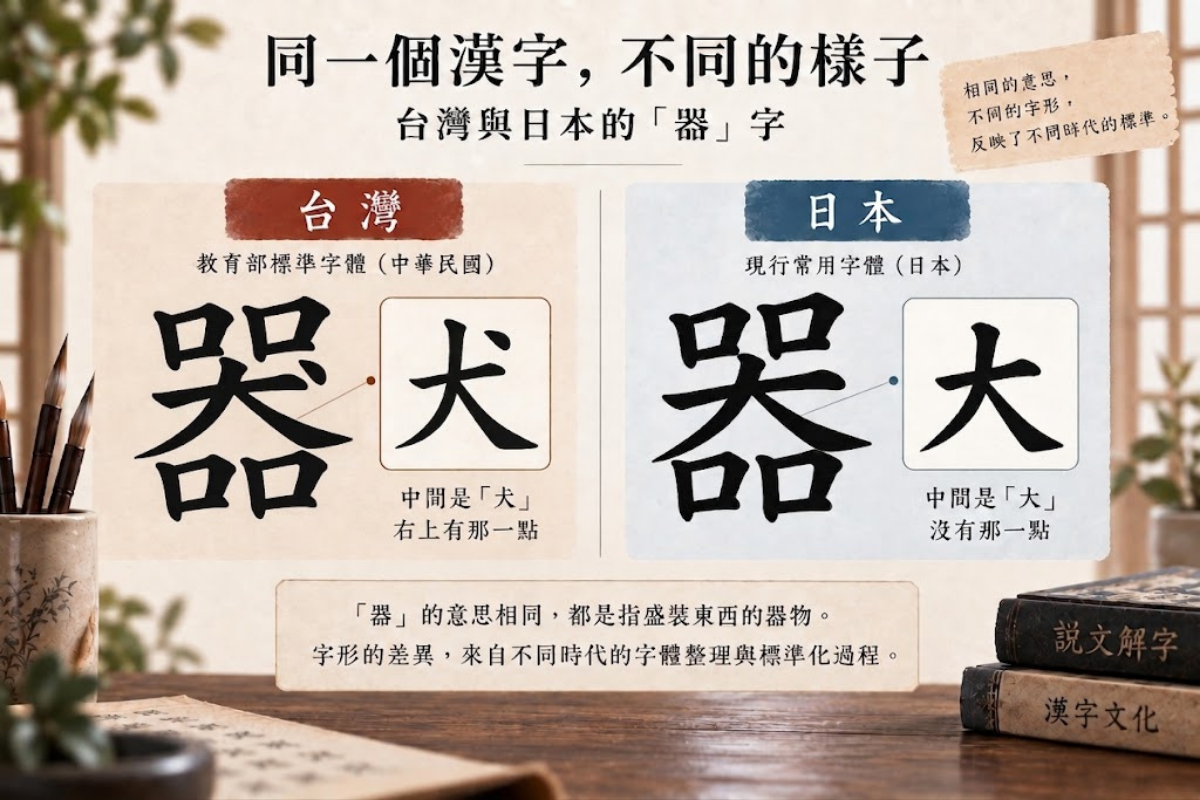
▲ The current forms of 器 in Taiwan and Japan have 犬 and 大 in the middle, respectively.
Why was that little dot missing? What was the story behind it?
1. 器: one character, different standard forms
In the Eastern Han dynasty, Xu Shen explained the character in the dictionary 《說文解字》 (Shuowen Jiezi):
「器,皿也。象器之口,犬所以守之。」
According to this explanation, 器 refers to vessels. The four 口 represent the openings of those vessels, while the 犬, or dog, in the middle guards them.
Still, the Shuowen reflects Xu Shen’s interpretation of the character’s form during the Eastern Han. As I read about later research into earlier writing, including bronze inscriptions, I realized that the history of 器 was not as straightforward as I had first imagined.
In the “History of Character Forms” section of Taiwan’s Ministry of Education’s 《異體字字典》 (Dictionary of Chinese Character Variants), I could see different ways of writing 器, from bronze inscriptions and small seal script to later dictionaries. Its entries on variant characters include many more forms of 器.
Ministry of Education’s 《異體字字典》
In other words, 器 has a very long history of changes in form. From bronze inscriptions and small seal script to later regular script, it has not always looked exactly the same. Taiwan’s current standard form and Japan’s older form, 器, both retain the 犬 component in the middle, though their exact shapes are not identical. Japan’s current standard form has 大 in the middle instead.
A form with 大 in the middle already existed long ago
When I first saw Japan’s 器, my natural guess was: had Japan simply left out the dot at the lower right of 犬 at some point?
It was only when I looked at the Ministry of Education’s Dictionary of Chinese Character Variants that I realized it was not that simple.
Among the variants of 器 in the dictionary is a form with 大 in the middle. The editorial explanation says:
「依《異體字例》,凡犬形多變作大」
This means that, according to 《異體字例》, 犬-shaped components often take the form 大 in variant characters. This form appears in the Northern Wei “Epitaph of Diao Zun” (〈刁遵墓誌〉), cited in 《金石文字辨異》.
So writing 犬 as 大 was not something invented in modern Japan. It was a variation that had already existed during the long history of Chinese character use.
That overturned my earlier assumption.
I then wondered: “When did Japan begin using the form of 器 with 大 in the middle as its standard?”
But as I kept looking, I realized there was an even more precise question:
“If 器 already had several written forms, why did Taiwan and Japan eventually choose different ones as their standards?”
Japan’s older 器 and today’s 器
Kanjipedia, published by the Japan Kanji Aptitude Testing Foundation, lists the current 器 as a 15-stroke character. It also lists the older 16-stroke form, 器.
Its explanation of the character’s origins describes 器 as a combination of 㗊, representing many containers, and 犬. The 器 now taught in Japan uses an abbreviated form.
Japan Kanji Aptitude Testing Foundation: Kanjipedia entry for 器
So Japan, too, once used an older form that kept 犬 in the middle.
When did Japan’s current 器 become the standard?
To find an answer, I turned to records of Japan’s modern kanji policies.
In 1946, Japan published the 《当用漢字表》, a list defining the range of kanji for everyday use. However, the original scan preserved by the Agency for Cultural Affairs is old. Even after enlarging it, I still could not confidently make out the precise details in the middle of 器.
Original PDF of the 1946 《当用漢字表》 (Agency for Cultural Affairs)
By the time of the 1947 《活字字体整理案》, a proposal to standardize printed character forms, 器 was among the characters being organized.
Looking closely at the original document, I could see that the variant listed was 噐, while the form adopted after standardization was 器 with 大 in the middle.
Original PDF of the 1947 《活字字体整理案》 (Agency for Cultural Affairs)
This document therefore lets us say one thing with confidence: by the 1947 standardization of printed character forms, at the latest, 器 with 大 in the middle had already been adopted.
But it does not prove that 1947 was the first time Japan changed 犬 to 大. The forms actually listed here are the variant 噐 and the standardized 器.
The records preserved by the Agency for Cultural Affairs explain that this work was undertaken because printed character forms differed across textbooks, newspapers, magazines, and other publications. The aim was to establish more consistent standards for printing.
The 1947 《活字字体整理案》 later also became the basis for the 《当用漢字字体表》.
In 1949, Japan published the 《当用漢字字体表》, formally establishing standard forms for the kanji on the everyday-use list. Its 器 is the form used today, with 大 in the middle.
The official explanation specifically mentions:
「異体の統合,略体の採用,点画の整理」
That is, unifying variant forms, adopting abbreviated forms, and organizing dots and strokes.
Official information on the 《当用漢字字体表》 (Agency for Cultural Affairs)
Still, Japan’s efforts to organize kanji forms did not suddenly begin after the war. The records preserved by the Agency for Cultural Affairs show that the organization of kanji and printed character forms had already been discussed several times before the war.
So what began for me as “Japan’s 器 is missing a dot” turned out to be more than simply deleting one dot.
A form of 器 with 大 in the middle had long existed among Chinese character variants. When Japan standardized character forms in modern times, it eventually chose this form as the standard. Taiwan’s current standard form retains the 犬 component in the middle.
The same character can end up with slightly different standard forms in different places.
That brought to mind another Japanese kanji I was curious about: 卓.
2. 桌: it looks like simplification, but the story is different
In Chinese, 桌 means a table. In Japanese, the usual word for a desk or table is 机(つくえ), but words such as “dining table” and “table tennis” use 卓.
For example, Chinese 桌球, “table tennis,” is 卓球(たっきゅう) in Japanese. For Chinese 桌上, “on the table,” Japanese has 卓上(たくじょう); for 餐桌, “dining table,” it has 食卓(しょくたく).
Had Japan removed 木, the “wood” component?
器: one fewer dot in Japan
桌: one fewer 木 in Japan
But after checking the characters’ origins and historical sources, I realized that although 器 and 桌/卓 seemed like similar cases, they were actually two different situations.
The Shuowen Jiezi already includes 卓:
「卓,高也。」
This defines 卓 as “high.” Its original core meaning was high, rising above, or standing out.
That meaning remains in the 卓 of words such as 卓越 (“outstanding”), 卓著 (“distinguished”), and 卓然 (“clearly standing out”).
Interestingly, the Shuowen Jiezi does not include 桌. In other words, in Xu Shen’s Eastern Han period, 桌 had at least not yet become a character included in that dictionary. 卓 is a very old character, much older than 桌.
3. No character 桌 does not mean no furniture with a tabletop
If there was no character 桌 in the Han dynasty, where did people eat, read, and put their things?
In fact, for a long period in ancient China, people sat on mats on the floor and generally used furniture called 几 and 案 in daily life.
A 几 was usually lower and smaller. It could hold objects and was also often used for leaning on. An 案 had a fuller surface for holding food, documents, utensils, and other things. Words still used today, such as 伏案工作 (“work bent over a desk”) and 書案 (“writing desk”), refer to this kind of furniture.
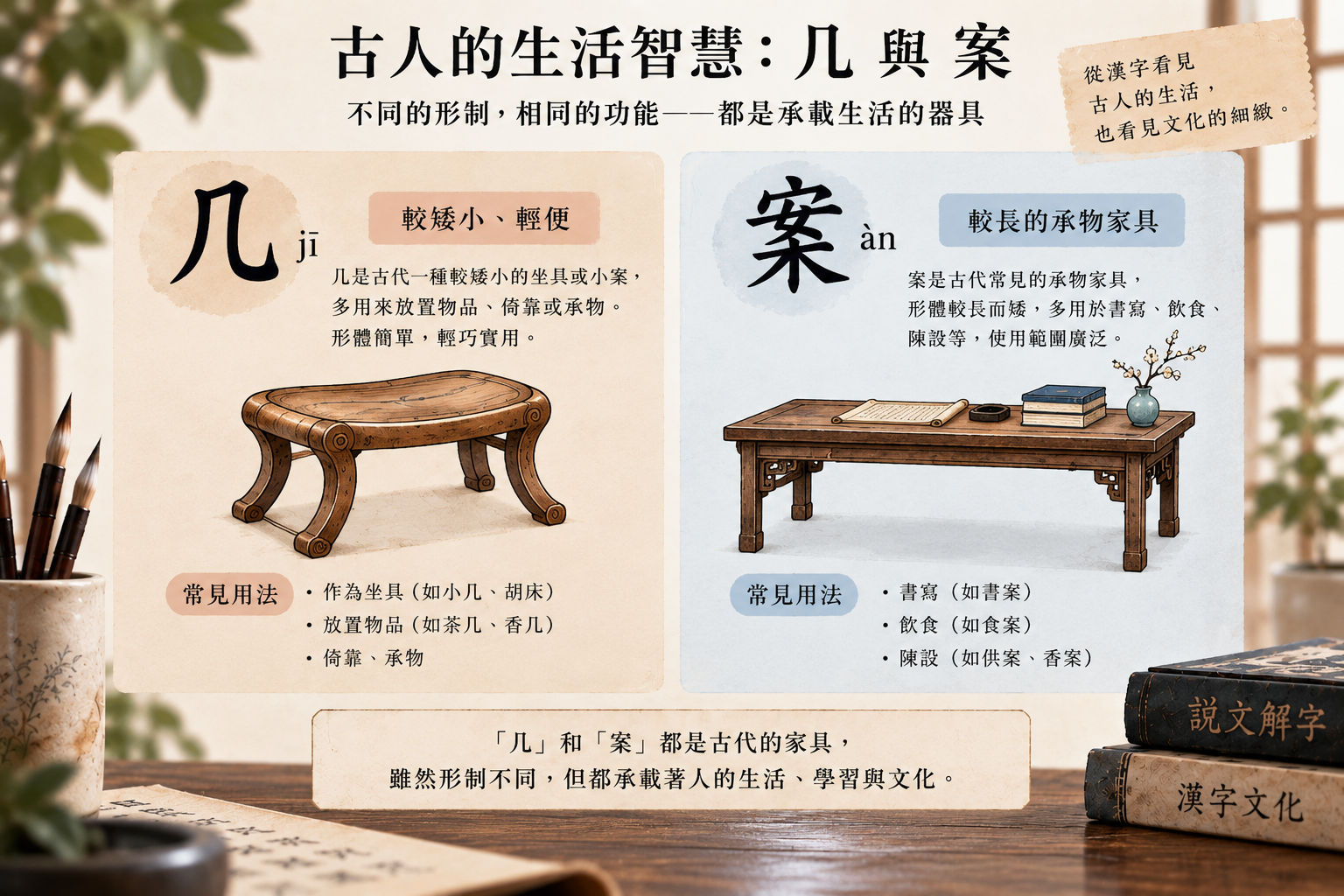
▲ 几 and 案 were both types of ancient furniture, but their designs and uses were not quite the same.
So the absence of the character 桌 does not mean people had no furniture to put things on. The forms of that furniture and the names used for it were simply different from today’s.
4. 桌 came later
Later, the character 桌 appeared. The dictionary evidence available lets us confirm that this form can already be found in the Northern Song dictionary 《廣韻》 (Guangyun), so 桌 already existed before the Song period, at the latest.
In bringing together material from dictionaries across the ages, the Ministry of Education’s Dictionary of Chinese Character Variants provides another important clue: 桌 was recorded early on as a variant of 卓.
Ministry of Education’s 《異體字字典》
Later, 桌 also came to refer to furniture such as 几 and 案. The dictionary 《正字通》 (Zhengzitong) records:
「俗呼几案曰桌。」
This says that furniture such as 几 and 案 was commonly called 桌. By then, 桌 had acquired a furniture-related meaning distinct from 卓.
So the use of 卓 in Japanese words such as 卓球 and 食卓 does not mean Japan took the 木 off the bottom of the Chinese character 桌. Quite the opposite: 卓 was already a character long before 桌 appeared.
Exploring the origins of Chinese characters lets us see traces of history and how culture has been passed down. I started by noticing a missing dot and a missing 木. But as I kept following those clues, I discovered just how many interesting stories can be tucked away behind a single character.